Showing posts with label Humdinger. Show all posts

Wednesday, October 28, 2009

The Commander's Intent

I recently read a blog that said we should not plan. While I am aware that plans are not fool-proof (see previous blog post), plans do help you think through issues and hopefully help provide great questions (more on this later).

What if, within your organization, people knew basically what to do without needing play-by-play instructions from their leaders? What if people could make decisions on their own and improvise when needed wherever they are and no matter the context? What if people were generating solutions, and this is the amazing part, everyone was on the same page rather than generating solutions that benefit different causes?

In the book Made To Stick (26), the Heath brothers talk to Colonel Kolditz in the U.S. military about how plans can quickly become obsolete on the battlefield, nicely captured in the phrase "no plan survives contact with the enemy." For you that may be "no sales plan survives contact with the customer" or "no lesson plan survives contact with teenagers." The military adapted a new planning process called Commander's Intent (CI).
CI is a crisp, plain-talk statement that appears at the top of every order, specifying the plan's goal, the desired end-state of an operation. At high levels of the Army, the CI may be relatively abstract: "Break the will of the enemy in the Southeast region." At the tactical level, for colonels and captains, it is much more concrete: "My intent is to have Third Battalion on Hill 4305, to have the hill cleared of enemy, with only ineffective remnants remaining, so we can protect the flank of Third Brigade as they pass through the lines."

The CI never specifies so much detail that it risks being rendered obsolete by unpredictable events. "You can lose the ability to execute the original plan, but you can never lose the responsibility of executing the intent," says Kolditz. In other words, if there's one soldier left in the Third Battalion on Hill 4305, he'd better be doing something to protect the flank of the Third Brigade.
...
Colonel Kolditz gives an example: "Suppose I'm commanding an artillery battalion and I say, 'We're going to pass this infantry unit through our lines forward.' That means something different to different groups. The mechanics know that they'll need lots of repair support along the roads, because if a tank breaks down on a bridge the whole operation will come to a screeching halt. The artillery knows they'll need to fire smoke or have engineers generate smoke in the breech area where the infantry unit moves forward, so it won't get shot up as it passes through. As a commander, I could spend a lot of time enumerating every specific task, but as soon as people know what the intent is they begin generating their own solutions."
Here is an example from a for-profit organization: Southwest. Any guesses on their Commander's Intent? "We are the low-fare airline." In the decision making process, you might have several options to choose from, but with the CI the decision making process has a filter question: which decision helps us stay the low-fare airline?

At the Combat Maneuver Training Center, the unit in charge of military simulations, recommends the officers arrive at the Commander's Intent by asking themselves two questions:
If we do nothing else during tomorrow's mission, we must ___________.

The single, most important thing we must do tomorrow is ___________.
Find the core of what this organization is about. Not two pages, not even two paragraphs. What is the core.

This can, and should, be applied to parenting, to religious institutions, to for-profit and not-for-profit organizations, to teams, etc. Two examples that I have used personally:

"We are training our kids to be capable and responsible adults by the time they leave our house at 18 years of age." Now there is a end-goal established with a definitive time-line. At each age we know we need to help them progress to being responsible for themselves; what should that look like at 18? How do we backtrack from there to where they should be at 13? This should also help make decisions about involvement in activities, family chores, etc. It is far more than just getting them to be behave like you want them to so they don't embarrass you in that moment.

"This church exists to train people to be every-day followers of Jesus." Training is more than lecturing, it also means helping people enact knowledge and behaviors into their lives. It can be applied to different demographics - how do we train students or parents or couples or seniors to be every-day followers of Jesus? It is far bigger mission than copying what you did last year so everyone is happy.

So what is your Commander's Intent?

Read More...

Digg this

Friday, October 23, 2009

The question is more important than you think

This quote from the book Buying In (40) fascinates me:
The vast majority of our brain's activities - 98% of it, by one estimation - happens outside of conscious awareness...Daniel Kahneman and Amos Tversky published work indicating that people make decisions about risk partly in reaction to how a problem is framed - their risk tolerance changes depending on the working of the question they are asked, even if the issue described is, in reality, identical.
What this means is that you can look at the exact same situation and make two very different decisions based on how someone asks you a question. Nothing about the reality of the situation is different, only the words used in the question asking you to make a decision - and that can change everything!

This means that you need to make sure that you are asking the best questions you can about important decisions for yourself, for your family, and for your teams. Brainstorm the best question that really needs to be answered.

Let's think through a scenario: Your son just came home with a D on his report card. Here are two questions you can ask. Think through your initial response to the first question before you move on to the second one.

1) How are you going to punish him?


2) How are you going to help train him?


Was their a difference in the possibilities that came into your head?

It is worth spending time making sure that you have the best goals for your family and your organization so that the right inquiries can be asked - your behavior and your activities are based more on the questions that you ask, and thus try to answer, rather than abstract concepts framed on a wall.

Here is a great example from the book Made To Stick(186, 187):
Army food is just about what you'd expect: bland, overcooked, and prepared in massive quantities. The dishes are not garnished with sprigs of parsley. The mess halls are essentially calorie factories, giving the troops the fuel they need to do their jobs. An old Army proverb says, "An Army travels on its stomach."

The Pegasus chow hall, just outside the Baghdad airport, has developed a different reputation. At Pegasus, the prime rib is perfectly prepared. The fruit platter is a beautiful assortment of watermelon, kiwi fruit, and grapes. There are legends of soldiers driving to Pegasus from the Green Zone (the well-protected Americanized area of Baghdad), along one of the most treacherous roads in Iraq, just to eat a meal.

Floyd Lee, the man in charge of Pegasus, was retired from his twenty-five-year career as a Marine Corps and Army cook when the Iraq war began. He came out of retirement to take the job. "The gook Lord gave me a second chance to feed soldiers," he said. "I've waited for this job all my life, and here I am in Baghdad."

Lee is well aware that being a soldier is relentlessly difficult. The soldiers often work eighteen-hour days, seven days a week. The threat of danger in Iraq is constant. Lee wants Pegasus to provide a respite from the turmoil. He's clear about his leadership mission: "As I see it, I am not just in charge of food service; I am in charge of morale."
...
This vision manifests itself in hundreds of small actions taken by Lee's staff on a daily basis. At Pegasus, the white walls of the typical mess hall are covered with sports banners. There are gold treatments on the windows, and green tablecloths with tassels. The harsh fluorescent lights have been replaced by ceiling fans with soft bulbs. The servers wear tall white chef's hats.

The remarkable thing about Pegasus's reputation for great food is that Pegasus works with exactly the same raw materials that everyone else does. Pegasus serves the same twenty-one-day Army menu as other dining halls. Its food comes from the same suppliers. It's the attitude that makes difference. A chef sorts through the daily fruit shipment, culling the bad grapes, selecting the best parts of the watermelon and kiwi, to prepare the perfect fruit tray. At night, the dessert table features five kinds of pie and three kinds of cake. The Sunday prime rib is marinated for two full days. A cook from New orleans orders spices that are mailed to Iraq to enhance the entrees. A dessert chef describes her strawberry cake as "sexual and sensual" - two adjectives never before applied to Army food.

Lee realizes that serving food is a job, but improving morale is a mission. Improving morale involves creativity and experimentation and mastery. Serving food involves a ladle.
What is my job, or What is my mission? How do we feed all these people, or how do we improve morale? How long must we work, or how do we make this incredible?

The power of questions.

Read More...

Digg this

Wednesday, August 19, 2009

The road you are on

"Roads are what we make of them."

Those words struck me and I can't get them out of my head.

They come from the book Traffic by Tom Vanderbilt (181) from a chapter in which he is describing a trip he took in Spain. One road he mistakenly took was through rural Spain that turned out to be "a climbing, twisting, broken-asphalt nightmare of blind hairpin turns." One of the few signs he saw said PELIGRO. How did he do? Just fine - because he took it incredibly slow and was intently focused on trying not to drive off the edge of a cliff. Later he was on a smooth, flat road with plenty of visibility and plenty of signage. What happened? He was so bored he started to fall asleep and almost ran off the road.

Actions like this are examples of the Peltzman Effect: the idea that when given warning signals or when provided with a safer environment, people tend to then offset the safety efforts by behaving in riskier ways.

We can be on a safe road and make it dangerous by our actions, or lack of them.

We can have a care-free day and fill it with worry. We can drive along with great company and fill it with silence. We can take a challenging road and grow with it, or avoid it all-together.

Our parenting, marriages, relationships, work, recreation, school, abilities, styles ... are what we make of them

Roads are what we make of them.

Read More...

Digg this

Monday, July 21, 2008

String Theory and My Lost Socks


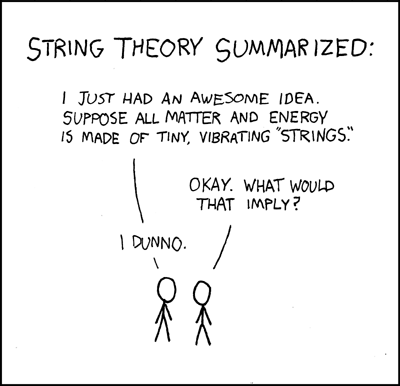
I've enjoyed listening to a number of TED talks lately, and today was no different. Brian Greene, a physicist, gave a talk on string theory. It is basically the search for a unification theory for the universe. Apparently, the answer doesn't revolve around ice cream sundaes on a warm summer evening. At least, for physicists.

Being a former physics genius (I once taught, or maybe a better word is "stumbled through" a basic physics lab for one semester), let me give you a basic summary: there are more dimensions out there than the three dimensions of space + time. How do we know this? Because it makes our cool looking calculations work if there are 11 dimensions.

I'm all for it. I mean, those socks go somewhere. And they reappear as lint in places that must come from some freaky dimension. If anyone asks me why I'm investing in the company Little Miss Matched, I say it's because there are too many dimensions for me to keep track of.

As if 4 wasn't enough. Just watching people drive should convince us to at least go back to 3.

Anyway, apparently below the atoms and within all that empty space of neutrons and protons and those zippy electrons, there are vibrating strings at the core of everything. These strings vibrate in different ways to produce what we are. This is actually a pretty cool image - Jimmy Hendrix is himself a complex guitar. It also gives me something to say the next time I blow it: "I'm just a little out of tune at the moment."

Read More...

Digg this

Thursday, January 11, 2007

Laughter

Ok, so I know that sometimes I get a little serious, so here is something on the lighter side. This if for all those whose laughter is contagious, and I've definitely known a few...

Read More...

Digg this